The best WooCommerce affiliate plugin for a store depends on three things: how commission has to be calculated (flat, per product, per affiliate, lifetime, recurring, multi-tier), how affiliates will be paid, and whether you also want customers referring friends. This comparison puts seven plugins side by side on exactly those points, with prices read from the vendors’ pages on 7 September 2026 and a verdict for each type of store. Affiliate and Referral Program for WooCommerce is our plugin; it is listed first because it is the one we can describe in full from its documentation and demo store, and where a statement about another plugin is the vendor’s own claim, the text says so.
If you are starting a program for the first time, read the step-by-step guide to starting an affiliate program alongside this page; if you are leaving AffiliateWP, the AffiliateWP alternatives comparison goes deeper on pricing and migration; and if multi-tier commissions are the reason you are here, the WooCommerce MLM plugins guide covers plan types and the arithmetic.
Table of Contents
The short list
| # | Plugin | Best for | Price (7 Sep 2026) |
|---|---|---|---|
| 1 | Affiliate and Referral Program for WooCommerce | Stores that want affiliates, a customer refer-a-friend program and multi-tier commissions in one WooCommerce-native plugin | $96 a year |
| 2 | Affiliate for WooCommerce (StoreApps) | Established programs that want a mature WooCommerce-only plugin with campaigns, multi-tier and a migration path | $179 a year |
| 3 | AffiliateWP | Sites that sell beyond WooCommerce and need its integration library or managed payouts | $149.50 first year, renews at $299; multi-tier from $209.65 |
| 4 | Solid Affiliate | Subscription and marketplace-style stores that want revenue sharing and a clean interface | $149.60 first year, renews at $374 |
| 5 | SliceWP | Stores that want to start free and upgrade once to a plan with every add-on | Free core; Pro $169 (list $229) |
| 6 | YITH WooCommerce Affiliates | Stores already built on YITH plugins that pay affiliates by bank transfer | Free version; premium yearly, price not shown on its page |
| 7 | Coupon Affiliates | Creator and influencer programs that attribute sales by coupon code | $17.99 a month or $134.99 first year, renews at $179.99 |
How we compared them
Each plugin was scored on the same eight questions: how commission rules can be set, how sales are attributed, how affiliates are paid, which fraud controls are named and how they work, whether a customer referral module is included as a separate program, whether multi-tier commission is available and in what form, what reporting and exports exist, and what the plugin costs in year one and at renewal. Prices come from the vendors’ pricing or product pages on 7 September 2026; feature notes come from those pages, the vendors’ documentation and our August 2026 research on nine WooCommerce affiliate plugins. Statements about Affiliate and Referral Program for WooCommerce come from its documentation and a demo store running the current version, which is where the screenshots are from. We did not run paid programs on the other plugins and do not claim to have.
What to check before you buy
- Commission rules and their base. Store-wide, per product, per category and per affiliate at minimum, and a clear statement of what the percentage applies to. Few vendors say whether tax, shipping and discounts are excluded; ask before you buy. Lifetime commissions, recurring commissions on subscriptions and rates that rise with performance are the extras to look for.
- Attribution. Cookie length, first-click or last-click, and whether a coupon code can credit an affiliate without a click. Coupon attribution matters for creators who talk rather than link.
- Payouts. Which methods are built in, whether PayPal payouts run as a batch through PayPal’s API, what needs an extra plugin, and whether affiliates can take store credit instead of cash. The paying affiliates page in our documentation shows what a built-in batch payout looks like.
- Fraud controls with named mechanisms. Self-referral blocking, coupon ownership, a visit log, manual approval and refund handling are checkable; “fraud prevention” as a label is not.
- A separate customer referral module if you want existing customers to refer friends for store credit. Converting customers into affiliates is a different thing, with different paperwork and rewards. If a refer-a-friend program is the main thing you want, our comparison of refer-a-friend and customer referral plugins covers the dedicated options.
- Multi-tier commission only if the program is designed around recruiting, and then with named plan types rather than a bare chain of referrers.
- Reporting and exports for you and for affiliates, so disputes can be settled from data.
- WooCommerce-native behaviour: commission from WooCommerce order lines, refunds handled, HPOS and block checkout declared, affiliates as WordPress users.
- The real price. First-year discounts, renewal prices, site counts and the add-ons or higher plans that hold the features you actually need.
Free versions exist: SliceWP’s core plugin, YITH’s free version and a few smaller plugins on WordPress.org cover link tracking, a single rate and manual payouts, and they are a reasonable way to learn what your program needs. What they leave out is the same list every time: per-product and per-affiliate rules, coupon attribution, automated payouts, fraud controls and a customer module. The plugin FAQ in our documentation answers the pre-purchase questions we are asked most often.
The 7 best WooCommerce affiliate plugins
1. Affiliate and Referral Program for WooCommerce
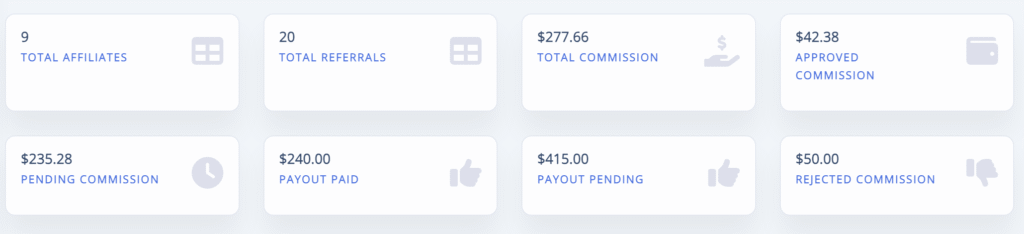
Affiliate and Referral Program for WooCommerce is sold on the WooCommerce Marketplace for $96 a year and runs three programs from one plugin: an affiliate program, a customer refer-a-friend program as a separate module with its own settings and wallet, and multi-tier (MLM) commissions with Binary, Forced Matrix, Unilevel and Unlimited plan types. Commission is calculated on each order line’s total after discounts, excluding tax and shipping, and rules apply in a fixed order: a rate for a specific affiliate, optionally limited to a product tag or category; a date-limited category promotion; per product; per category; then the store-wide rate. Lifetime commissions, recurring commissions on WooCommerce Subscriptions renewals and performance-based direct commission (User Levels), which raises an affiliate’s own rate at referral or sales targets, are included. The commission rules guide shows every field.
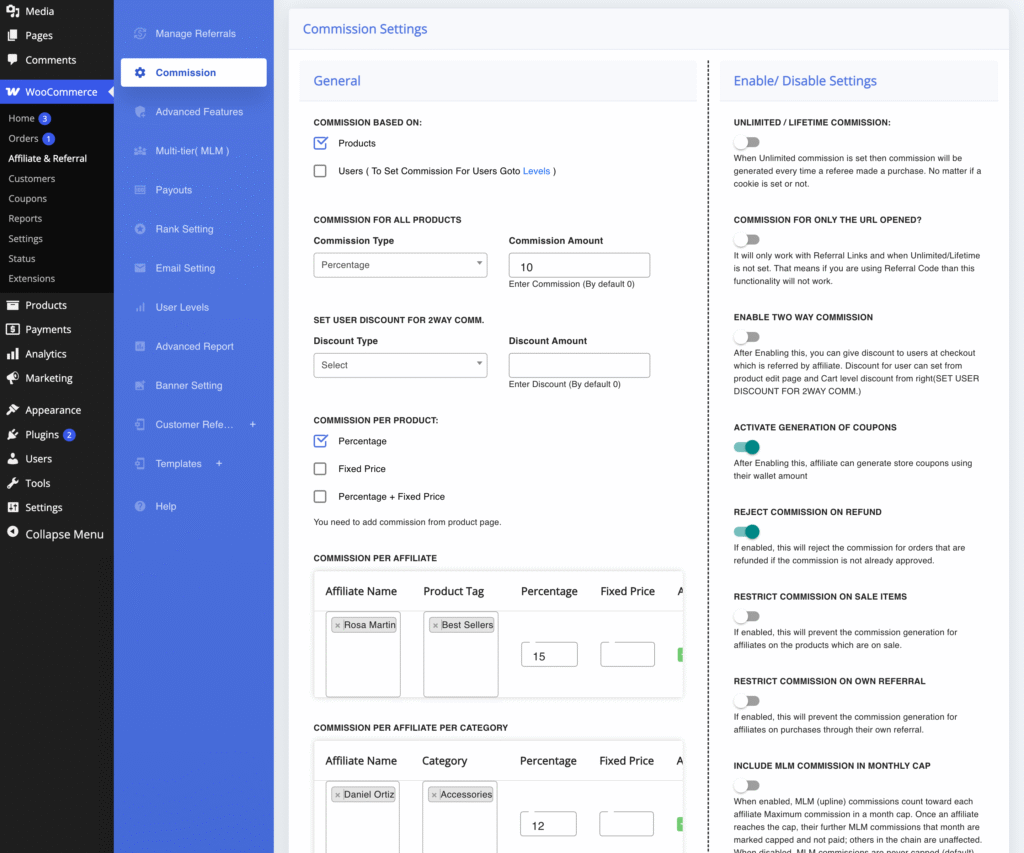
Affiliates get a dashboard on the store with a link generator for any URL, QR codes, share buttons, banners, a coupon they can be assigned so that a code alone credits the sale, reports and a wallet. Payouts run from one admin screen: PayPal through the PayPal Payouts API in one batch, Stripe through a free add-on, bank payouts recorded by hand, and wallet balance that affiliates can turn into a store coupon. Fraud controls are specific: a self-referral restriction (off by default, switch it on), coupon ownership enforcement, a visit log with device, browser and IP, manual approval of affiliates and referrals, and rejection of pending commissions when an order is refunded. HPOS and block checkout are declared, and the plugin ships with nine translations.
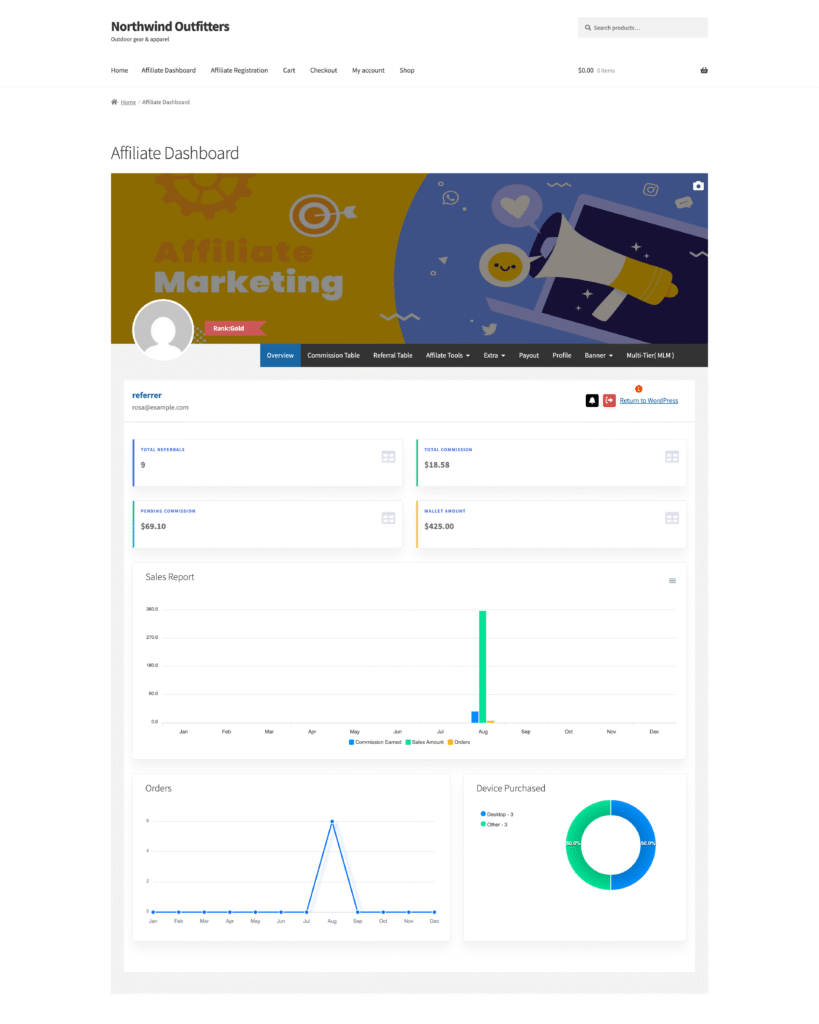
Where it falls short: tracking runs in the visitor’s browser, so test it with your caching and consent tools before launch; lifetime commissions apply to logged-in customers only; Stripe needs the free add-on; and the settings surface is large enough that an hour with the documentation is time well spent. Best for: stores that want affiliates, customer referrals and multi-tier commissions from one WooCommerce-native plugin at one price.
2. Affiliate for WooCommerce (StoreApps)
The longest-established WooCommerce-only affiliate plugin, at $179 a year for one site on storeapps.org and in local currency on the WooCommerce Marketplace, where it shows a 4.5-star rating from 123 reviews. It offers six or more commission types including per-product, per-category and per-affiliate rates, lifetime commissions and multi-tier commissions with unlimited levels; payouts through PayPal and Stripe, automated or manual, plus bank transfer, with store credit through the company’s separate Smart Coupons plugin; campaign-style creatives; a large documentation hub; and a one-click import of affiliates from AffiliateWP and Ultimate Affiliate Pro. Where it falls short: customers are converted into affiliates rather than served by a separate referral module, store credit costs a second plugin, the multi-tier network is a chain without plan types, and the page does not state the commission base. Best for: established programs that want a mature WooCommerce-only plugin and a documented migration path.
3. AffiliateWP
The best-known affiliate plugin for WordPress as a whole, with the widest integration library in this comparison and a managed Payouts Service on every plan. On 7 September 2026 its plans were Personal at $149.50 for the first year renewing at $299, Plus at $179.55 renewing at $399, Pro at $209.65 renewing at $599 and a Growth Bundle at $314.55 renewing at $699, all labelled introductory pricing with renewals at full price. Multi-tier commissions, recurring referrals, tiered affiliate rates and the Fraud Prevention Suite start at Pro; customer rewards come through its separate RewardsWP product. Where it falls short: the features most WooCommerce stores want sit in the Pro plan, there is no wallet or named plan types, and it is not WooCommerce-specific. Best for: sites whose affiliates promote memberships, forms or downloads as well as WooCommerce products. Our AffiliateWP alternatives comparison covers the switch in detail.
4. Solid Affiliate
A WooCommerce-only plugin with a clean interface, first-party cookies, per-affiliate, product, category and group rates, subscription-renewal rates, revenue sharing between product owners, PayPal Business payouts and store credit. Its pricing page on 7 September 2026 listed Starter at $149.60 for one site, Expert at $174.65 for three and Pro at $224.70 for ten, all introductory, renewing at $374, $499 and $749; lifetime commissions, revenue sharing, the Fraud Prevention Suite, a white-label affiliate area and landing pages are Pro-only. Where it falls short: no multi-tier commissions in any plan, no customer referral module, the fraud suite is a label without published mechanisms, and the Pro renewal is the highest in this comparison. Best for: single-level programs on subscription or marketplace-style stores whose owners value the interface.
5. SliceWP
A free core plugin on WordPress.org with a well-regarded reputation, and two paid plans that state every feature and add-on is included: Pro at $169 a year for one site with a list price of $229, and Pro Plus at $259 for ten, with lifetime licences at $429 and $649 on 7 September 2026. The add-ons cover multi-level commissions with generic levels and PayPal and Stripe payouts. Where it falls short: no customer referral module, no wallet, no plan types for the multi-level add-on, and support and updates stop when the subscription lapses. Best for: stores that want to start free and upgrade once to a straightforward program.
6. YITH WooCommerce Affiliates
A free version on WordPress.org that is unusually explicit about its mechanics, with referrer-ID tracking, a configurable cookie, self-purchase prevention, tax and discounts excluded from the commission base and manual bank payouts, and a premium version sold as a yearly licence on yithemes.com; the product page we checked on 7 September 2026 did not display a price. The premium version adds per-user, per-role, per-product and per-category rates, coupons, payment scheduling and withdrawal requests with invoices. Paying through PayPal Payouts, Stripe Connect or Account Funds requires the matching YITH plugin in each case. Where it falls short: no multi-tier commissions, no customer referral module, and automated payouts cost one or two extra plugins. Best for: stores already built on YITH plugins that pay affiliates by bank transfer.
7. Coupon Affiliates
Attribution by coupon code first and links second, with a polished standalone affiliate portal, global, per-affiliate and group rates, goal-based performance bonuses, sub-affiliate commissions, payouts through PayPal, Stripe, Wise and store credit, and support for subscriptions. On 7 September 2026 one site cost $17.99 a month, $134.99 for the first year renewing at $179.99, or $449.99 for life, with a 7-day free trial. Where it falls short: the customer referral option is described only briefly by the vendor, fraud controls are listed without mechanisms, and the yearly price after the first year is above SliceWP and close to Affiliate for WooCommerce. Best for: influencer and creator programs built around codes.
Comparison table
Single-site prices as displayed on 7 September 2026. “Not stated” means the vendor’s page did not say; it does not mean the feature is missing.
| Plugin | Price (7 Sep 2026) | Commission rules | Multi-tier | Customer referral module | Payouts | Fraud controls named | Free version |
|---|---|---|---|---|---|---|---|
| Affiliate and Referral Program for WooCommerce | $96 a year | Store-wide, product, category, per-affiliate with tag or category, dated category promotions; performance-based rates; lifetime; recurring | Binary, Forced Matrix, Unilevel, Unlimited | Yes, separate module with its own wallet | PayPal Payouts API batch, Stripe through the free add-on, bank, wallet to store coupon | Self-referral restriction, coupon ownership, visit log, manual approval, pending commission rejected on refund | No |
| Affiliate for WooCommerce (StoreApps) | $179 a year | Six or more types incl. product, category, affiliate; lifetime | Unlimited levels, chain | No; customers become affiliates | PayPal and Stripe automated, bank; store credit via Smart Coupons | Self-referral blocking | No |
| AffiliateWP | $149.50, renews $299; Pro $209.65, renews $599 | Per-affiliate and product rates; recurring referrals and tiered affiliate rates at Pro | Pro and above | No; separate RewardsWP product | Payouts Service, PayPal, store credit | Fraud Prevention Suite (Pro) | No |
| Solid Affiliate | $149.60, renews $374; Pro $224.70, renews $749 | Per affiliate, product, category, group; subscription rates; lifetime (Pro); revenue sharing (Pro) | No | No | PayPal Business, store credit | Fraud Prevention Suite (Pro), mechanisms not published | No |
| SliceWP | Free core; Pro $169 (list $229) | Per affiliate and product; all add-ons in Pro | Multi-level add-on, generic levels | No | PayPal and Stripe add-ons (Pro) | Not stated on the pricing page | Yes |
| YITH WooCommerce Affiliates | Free; premium yearly, price not shown | Per user, role, product, category (premium); tax and discounts excluded from the base | No | No | Bank; PayPal Payouts, Stripe Connect, Account Funds each need another YITH plugin | Self-purchase prevention; IP logging (premium) | Yes |
| Coupon Affiliates | $17.99 a month; $134.99, renews $179.99; $449.99 lifetime | Global, per-affiliate, group; bonuses; subscriptions | Sub-affiliate commissions | Basic option (vendor claim) | PayPal, Stripe, Wise, store credit | Listed without mechanisms | No; 7-day trial |
Affiliate commission plugins vs vendor commission plugins
Searches for a commission plugin for WooCommerce lead to two different products, and the word commission hides the difference. An affiliate commission plugin, which is what this page compares, pays outside promoters a share of the sales they refer to your store. A vendor commission plugin splits each sale between the marketplace owner and the vendor who listed the product, and belongs to multi-vendor marketplace software. If you run a marketplace and want to keep a percentage of every vendor’s sale, you need the second kind, and none of the plugins on this page does that job.
Which one for your store
- First program on a small or mid-sized store: Affiliate and Referral Program for WooCommerce, or SliceWP’s free core if you want to learn before paying.
- Affiliates and customer referrals from one plugin: Affiliate and Referral Program for WooCommerce; it is the only one here with a separate refer-a-friend module.
- Multi-tier commissions with a structure: Affiliate and Referral Program for WooCommerce for named plan types; Affiliate for WooCommerce for an unlimited-level chain.
- Sales outside WooCommerce too: AffiliateWP.
- Subscription or marketplace-style store with revenue sharing: Solid Affiliate.
- Creator programs run on codes: Coupon Affiliates.
- A store already built on YITH plugins: YITH WooCommerce Affiliates.
Whichever you pick, set the commission rules and the payout cadence before you invite anyone, and place one test order through a link and one through a coupon. Our guide to commission structures and rates covers what to set them to. The complete RedefiningTheWeb reference for our plugin lists every setting for the first entry on this page.
Want affiliates, customer referrals and multi-tier commissions from one plugin?
Affiliate and Referral Program for WooCommerce is sold on the WooCommerce Marketplace for $96 a year, with PayPal batch payouts, the wallet and every commission structure on this page included.
Related guides:
Frequently asked questions
Which WooCommerce affiliate plugin is best for a small store?
One that runs inside WooCommerce, prices per site rather than per plan, and covers the basics without add-ons: store-wide and per-product rates, coupon attribution, PayPal payouts and manual approval. On price, Affiliate and Referral Program for WooCommerce at $96 a year and SliceWP’s free core with a $169 upgrade are the two lowest entry points in this comparison; on features included at that price, ours covers the most.
Do I need a WooCommerce-specific affiliate plugin or a general WordPress one?
If everything you sell goes through WooCommerce, a WooCommerce-specific plugin calculates commission from real order line totals, handles refunds and coupons natively and declares HPOS and block-checkout support. A general WordPress plugin such as AffiliateWP earns its place when affiliates also promote memberships, forms or downloads sold outside WooCommerce.
What does a WooCommerce affiliate plugin cost in 2026?
On 7 September 2026 the yearly prices in this comparison ran from $96 (Affiliate and Referral Program for WooCommerce) through $134.99 first year for Coupon Affiliates, $149.50 for AffiliateWP Personal and $149.60 for Solid Affiliate Starter, $169 for SliceWP Pro and $179 for Affiliate for WooCommerce; several renew higher, and AffiliateWP’s multi-tier commissions need the $209.65 Pro plan that renews at $599.
Can an affiliate plugin also run a customer refer-a-friend program?
Only if it ships one as a separate module. Affiliate and Referral Program for WooCommerce runs a customer refer-a-friend program with its own rewards and wallet next to the affiliate program; Affiliate for WooCommerce converts customers into affiliates instead, AffiliateWP sells RewardsWP as a separate product, and the others in this comparison are affiliate-only or describe the option only briefly.
Is an affiliate commission plugin the same as a vendor commission plugin?
No. An affiliate commission plugin pays outside promoters a share of the sales they refer. A vendor commission plugin splits each sale between a marketplace owner and the vendor who listed the product, which is a multi-vendor marketplace feature. Every plugin on this page is the first kind.